
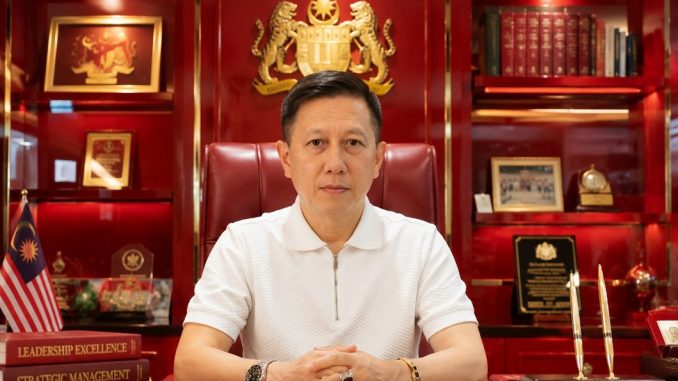

Selangor, QClubInternational – In an era defined by geopolitical tensions, economic uncertainty, and rapid global transformation, Indonesian journalist Roy Agusta engages in an in-depth conversation with Christian Kingsley Goh, a prominent Malaysian businessman, to explore the shifting dynamics of Malaysia’s economy.
The discussion focuses on how global conflicts, changing trade patterns, investment movements, and emerging economic challenges are influencing Malaysia’s position in the international landscape. Through a balanced and analytical perspective, the interview examines the risks, opportunities, and strategic responses needed for Malaysia to navigate an increasingly complex global economy.
QClub:
The global economy is currently facing significant pressure. Geopolitical conflicts, trade tensions, supply chain disruptions, and shifting international alliances have created uncertainty across markets. How do you view Malaysia’s position amid this changing global landscape?
Christian Kingsley Goh:
Malaysia is currently positioned in a unique situation. Although the country is not directly involved in major geopolitical conflicts, its economy is deeply connected to global trade and international investment flows.
As a highly open economy, Malaysia has benefited from globalization, but it has also become exposed to global risks. When global stability is maintained, trade and investment move efficiently. However, when conflicts emerge, economic pressure is created through energy prices, logistics costs, inflation, and market uncertainty.
The impact is not only experienced by governments or corporations; it is also felt by ordinary citizens through changes in living costs and purchasing power.

QClub:
Many analysts believe the world is entering a new era of economic fragmentation, where countries are becoming more cautious about depending on certain geopolitical blocs. How will this affect Malaysia?
Christian Kingsley Goh:
This transformation will certainly affect Malaysia. For decades, global supply chains were designed based on efficiency, production was placed where costs were lower and operations were faster. Today, geopolitical risks have changed the calculation.
Companies are no longer asking only, “Where can we produce at the lowest cost?” They are also asking, “Is this supply chain politically and strategically secure?”
This situation creates both opportunities and challenges for Malaysia. On one hand, Malaysia could benefit as companies diversify their manufacturing bases. On the other hand, stronger competition will emerge from other countries seeking the same investments.
Malaysia must strengthen infrastructure, improve human capital, accelerate innovation, and maintain policy consistency to remain competitive.
QClub:
How significant is the influence of global conflicts on foreign investment in Malaysia?
Christian Kingsley Goh:
Foreign investors usually evaluate three important factors: stability, certainty, and growth potential. In uncertain times, investment decisions become more carefully calculated. Investors do not only consider incentives or operational costs; they also evaluate governance quality, regulatory stability, workforce capability, and long-term economic direction.
Malaysia still holds strategic advantages, particularly through its geographical position, its role within ASEAN, and its experience in manufacturing and technology-related industries. However, opportunities will not automatically remain. Countries that adapt faster will attract more capital.
QClub:
The public has experienced rising costs of living. Should this situation be viewed mainly as a result of global conflicts?
Christian Kingsley Goh:
Economic challenges are usually caused by multiple factors.
Global conflicts can influence energy prices, food supply, and transportation costs. However, domestic factors also play an important role, including productivity, economic management, fiscal policies, and income distribution.
A complex economic issue should not be explained by a single cause. External pressure may create challenges, but the way those challenges affect society depends heavily on domestic resilience and policy responses.
QClub:
Some argue that Malaysia should become more economically independent and reduce its dependence on global markets. Is this a realistic approach?
Christian Kingsley Goh:
Economic independence should not be misunderstood as isolation. No modern economy operates completely alone. Even the largest economies remain connected through trade, technology, and international cooperation.
What Malaysia needs is not isolation, but stronger economic resilience. The country must strengthen strategic sectors such as technology, food security, energy, digital transformation, and high-value industries. The goal is not to withdraw from globalization, but to build a stronger position within it.
QClub:
What role does the younger generation play in facing this economic transformation?
Christian Kingsley Goh:
The younger generation will become a major force in determining Malaysia’s economic future. The global economy is shifting from a labor-driven model toward a knowledge-based economy. Artificial intelligence, automation, and digital transformation are changing how people work.
The key question is no longer only about job availability, but whether human skills can adapt to future demands. Education, creativity, entrepreneurship, and innovation must become national priorities. A country’s strength is no longer measured only by natural resources, but by its ability to create knowledge and value.
QClub::
How do you see the future of Malaysia’s economy amid global geopolitical uncertainty?
Christian Kingsley Goh:
Malaysia is standing at a critical crossroads. There are risks: global economic slowdown, geopolitical tension, investment competition, and increasing pressure on household expenses.
But there are also opportunities: ASEAN growth, digital transformation, green economy development, and global supply chain restructuring. The future will belong to countries that do not simply react to change, but actively prepare and create new opportunities.
QClub:
What is your message to readers?
Christian Kingsley Goh:
The world is entering a new economic era. The stability that existed for decades is being challenged. The future economy will not only be about growth numbers, but about resilience, adaptability, and the ability to create sustainable value. A strong nation is not one that never experiences crisis, but one that can transform uncertainty into opportunity. Overall, Malaysia has responded to the emerging challenges with considerable foresight and preparedness. Compared to many other affected nations, the country appears more resilient and better positioned to manage the ongoing geopolitical and economic shifts
Leave a Reply