
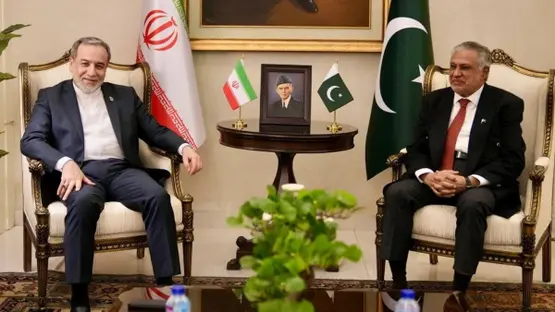

Malaysia, QClubInternational – Pakistan continues its peacemaking efforts as a mediator, at a time when the United States and Iran remain divided over Iran’s enriched uranium stockpiles and control over the Strait of Hormuz. Pakistan’s Interior Minister Syed Mohsin Naqvi, as reported by Al Arabiya on Friday, 22 May 2026, held a meeting with Iranian Foreign Minister Abbas Araghchi on the same day, local time.
The talks, hosted in Tehran, were intended to discuss proposals aimed at ending the conflict involving Iran, the United States, and Israel. This meeting came roughly two days after Naqvi delivered the latest message from the United States to Iran as part of ongoing indirect negotiations.
Reports from Iran’s ISNA and Tasnim news agencies indicated that Naqvi is facilitating communication between the two sides, with the goal of establishing a framework to end hostilities and resolve outstanding differences. Separately, US Secretary of State Marco Rubio told reporters that there are “some positive signs” emerging from the discussions. However, Rubio warned that no deal would be possible if Tehran were to impose transit fees on vessels passing through the Strait of Hormuz — a waterway that has effectively been closed to commercial traffic since the war began.
“There are some positive signs,” Rubio stated. “But I do not want to be overly optimistic… We will have to wait and see what unfolds in the coming days.” A senior Iranian source told Reuters on Thursday, 21 May, that gaps between the parties have narrowed, though issues surrounding uranium enrichment and the status of the Strait of Hormuz remain major points of contention.
The conflict, which started in late February, has severely disrupted the global economy. Surging oil prices have raised fears of widespread inflation, especially since roughly 20% of the world’s oil and liquefied natural gas supplies passed through the Strait of Hormuz before hostilities broke out.
Market reactions reflected the uncertainty: the US dollar neared a six-week high on Friday, while oil prices climbed as investors doubted the likelihood of an immediate breakthrough. “We are now entering the 12th week of conflict, with six weeks under a partial ceasefire, and I am not convinced we are moving any closer to a resolution between the US and Iran,” said Tony Sycamore, a market analyst at IG Australia, commenting on the situation in the Middle East.
Strategic Importance of the Strait of Hormuz: The strait is the world’s most critical oil transit chokepoint. According to data from the US Energy Information Administration (EIA), approximately 21 million barrels per day, or about 20% of total global crude oil and condensate trade, passed through the waterway in recent years. Any closure or restriction typically triggers sharp price spikes and volatility in energy markets. –
Iran’s Nuclear Program: The dispute over enriched uranium centers on the level of purity and quantity of stockpiles. Under previous international agreements, Iran agreed to limit enrichment; however, in subsequent years, it has increased both the volume and purity of its enriched uranium, raising concerns from Western nations regarding potential military applications. –
Pakistan’s Mediation Role: Pakistan has a history of acting as a diplomatic bridge between regional and global powers. Its geostrategic position and long-standing ties with both Iran and the United States make it a viable channel for indirect diplomacy, though past mediation efforts have faced challenges due to deep-seated mistrust between the main parties. –
Global Economic Impact: Conflicts affecting energy supply routes have broad consequences. Research from the International Energy Agency (IEA) notes that sustained disruptions in the Strait of Hormuz could reduce global supply capacity significantly, driving up production costs, increasing inflationary pressure, and slowing economic growth worldwide. –
Indirect Negotiation Framework: Dialogue through intermediaries is a common approach when direct relations are severed. This method was also used during the negotiation of the Joint Comprehensive Plan of Action (JCPOA) in 2015, where multiple nations acted as facilitators before a formal agreement was reached. Would you like me to also format this into a news article style with proper paragraphs and headlines for easier reading or sharing?

Leave a Reply